My Young Goth Friend would like to ask some advice from anyone who would like to leave a comment here.
My friend has a problem, a big problem; she when she get depressed she er. . .cuts herself, or burns herself. This is called Self-Injury or Self-Mutilation and is a very serious problem. And yes her dad is trying to get her a good doctor, and she has been to a specialist.
Here's the question: what can she do to replace this self-distructive behavior?
Please post your answers here, or on her blog that I have set a link to above, and there is another link to the side of my blog.
Thank you.

Friday, February 03, 2006


Thursday, February 02, 2006
Lady Jan on my cartoon blog
I found some more of my old cartoons, so I added two of them to my cartoon blog. And I will add more later on.
So if you like my cartoons, please keep posting coments! That'll encourage me to keep adding them, and maybe making new ones.
So if you like my cartoons, please keep posting coments! That'll encourage me to keep adding them, and maybe making new ones.
Wednesday, February 01, 2006
More On Solar Roofs
As our dependence on natural gas drives up winter energy bills 40 to 70 percent, what will happen with our Million Solar Roofs campaign?
In addition to reducing global warming pollution, a million solar roofs mean 3,000 MW of energy, the equivalent of six giant power plants. This investment will ease demand for limited fossil fuels, hedge against higher prices and bring economic benefits to all.
So, after the Million Solar Roofs Bill, SB 1, failed to pass the Legislature in September, what can we expect of this important initiative in the coming year?
On January 12, 2006, the California Public Utilities Commission (CPUC) is expected to approve a landmark 10-year, $3.2 billion incentive program for homes, businesses, farms and schools to go solar. This giant pot of money, called the California Solar Initiative (CSI), is the core of SB 1 and aims to drive down costs by driving up demand.
When the Legislature reconvenes in 2006, the remaining policy elements of SB 1 still await approval by the Assembly. These policies will play a key supporting role to the CSI and include the requirements that solar become a standard option on all new homes and that utility companies give a million new solar customers a credit on their electric bill for excess solar power.
In light of rising energy prices and continued air pollution problems, we look forward to working with both the CPUC and the Assembly to enable California to quickly get on track to building a million solar roofs, lowering the cost of solar, and putting the power of the sun in the hands of everyday Californians.
----------------------------------------------------------------
City of Roseville to go solar (My uncle Bruce lives there)
On November 2nd, the City of Roseville, just east of Sacramento, approved a first-ever program aimed at building 20 percent of new homes with solar panels. The program will aim to build up to 4,000 solar homes in 10 years and is expected to be finalized in June 2006.
“As far as we know, this is a California first,” said Bernadette Del Chiaro, Environment California’s clean energy advocate. “As rising natural gas prices hit home this winter, this is the kind of solution-oriented policy making urgently needed.”
Roseville is one of the fastest growing cities in the region, expecting to add 20,000 new homes in the next ten years. Growth will bring increased energy demands.
According to the proposal, a BEST Home would save homeowners more than $100 per year after modest rebates and with energy efficiency features. The city and ratepayers would benefit from reduced pressure to build fossil fuel power plants.
“Solar homes are a win-win for everyone,” said Del Chiaro. “We applaud Roseville’s leadership.”
Clean Energy Advocate Bernadette Del Chiaro.
--------------------------------------------------------------------------------
In addition to reducing global warming pollution, a million solar roofs mean 3,000 MW of energy, the equivalent of six giant power plants. This investment will ease demand for limited fossil fuels, hedge against higher prices and bring economic benefits to all.
So, after the Million Solar Roofs Bill, SB 1, failed to pass the Legislature in September, what can we expect of this important initiative in the coming year?
On January 12, 2006, the California Public Utilities Commission (CPUC) is expected to approve a landmark 10-year, $3.2 billion incentive program for homes, businesses, farms and schools to go solar. This giant pot of money, called the California Solar Initiative (CSI), is the core of SB 1 and aims to drive down costs by driving up demand.
When the Legislature reconvenes in 2006, the remaining policy elements of SB 1 still await approval by the Assembly. These policies will play a key supporting role to the CSI and include the requirements that solar become a standard option on all new homes and that utility companies give a million new solar customers a credit on their electric bill for excess solar power.
In light of rising energy prices and continued air pollution problems, we look forward to working with both the CPUC and the Assembly to enable California to quickly get on track to building a million solar roofs, lowering the cost of solar, and putting the power of the sun in the hands of everyday Californians.
----------------------------------------------------------------
City of Roseville to go solar (My uncle Bruce lives there)
On November 2nd, the City of Roseville, just east of Sacramento, approved a first-ever program aimed at building 20 percent of new homes with solar panels. The program will aim to build up to 4,000 solar homes in 10 years and is expected to be finalized in June 2006.
“As far as we know, this is a California first,” said Bernadette Del Chiaro, Environment California’s clean energy advocate. “As rising natural gas prices hit home this winter, this is the kind of solution-oriented policy making urgently needed.”
Roseville is one of the fastest growing cities in the region, expecting to add 20,000 new homes in the next ten years. Growth will bring increased energy demands.
According to the proposal, a BEST Home would save homeowners more than $100 per year after modest rebates and with energy efficiency features. The city and ratepayers would benefit from reduced pressure to build fossil fuel power plants.
“Solar homes are a win-win for everyone,” said Del Chiaro. “We applaud Roseville’s leadership.”
Clean Energy Advocate Bernadette Del Chiaro.
--------------------------------------------------------------------------------
Sunday, January 29, 2006
More on College drinking by Lady Jan
I just want to explain that I was not talking about casual drinking in the earlier post, but the over-indulgent or binge drinking that causes alcohol poisoning and even death.
I like to thank everyone who posted a comment on the This has been going on long enough! post, I'm glad to see everyone's opintion on this important issue.
Here are some sad info, it explain that this is a wide spread issue:
Authorities said 19-year-old Samantha Spady died of alcohol poisoning Sept. 6 after consuming 30 to 40 beers and vodka drinks in 11 hours. Her body was found in a fraternity house at Colorado State University in Fort Collins.
Her mother says it's still hard for her to believe this happened to her daughter — an honors student, former homecoming queen and cheerleader.
"That wasn't my daughter," said Patty Spady, of the heavy drinking that went on the night her daughter died.
"Samantha was the girl next door," she said. "She was anybody's friend. This could happen to anybody."
Trying to Prevent Similar Losses
http://abcnews.go.com/GMA/story?id=127571&page=1
That realization has led the Spadys to create a foundation to try to prevent other parents from suffering similar losses.
The Spadys say the SAM [Student Alcohol Management] Spady Foundation will develop peer-to-peer counseling and other services meant to reduce the risk of alcohol abuse.
Rick and Patty Spady said their daughter was partying with friends after a football game the night she died, but they said they do not yet have all of the information about what happened.
According to authorities, Samantha, a sophomore business major from Beatrice, Neb., had a blood-alcohol level of 0.436 when she died. In Colorado, a person with a blood-alcohol level about 0.08 percent is considered too intoxicated to drive.
Dean Beers, the Larimer County deputy coroner, said a blood-alcohol level of just 0.40 is considered potentially lethal. Beers said the young woman's death was ruled accidental and there was no sign of foul play.
Anatomy of alcohol poisoning is as scary as the effects
By Kathleen Sullivan
For The Collegian
"Just let him sleep it off."
You or someone you know may have spent that dreaded evening helping out a friend who had "a little too much to drink" that night. He had alcohol poisoning-- but the worst part is that after he passed out, there was a chance that he wouldn't wake up.
What is alcohol poisoning? There is no one-word answer. Linda LaSalle, Community Health Educator at University Health Services, defined alcohol poisoning as an overdose of alcohol in the body. "When you have alcohol poisoning, your liver has more alcohol in it than it can process in an efficient amount of time. Your organs that process food and other chemicals cannot handle the amount of toxins present in your body," she said. Alcohol poisoning is also a potentially life threatening condition that most college students ignore.
Someone who has alcohol poisoning usually has the following symptoms:
*Person is passed out/unconscious
*Skin is blue or purplish
*Breathing is reduced to eight or less breaths per minute
*Person is vomiting while awake or sleeping
What most students do not know is that once they have reached the stage where they are passed out, they no longer have control over their basic functions, such as breathing. LaSalle said, "If someone is undergoing these symptoms, a friend should dial 911 immediately and turn the victim on their side so that they do not potentially choke on their own vomit. Blood alcohol content (BAC) actually rises when a person is unconscious so the worst thing a friend could do is let the alcohol poisoned victim 'sleep it off' or pass out."
The buzz on booze
In the past three years, statistics indicate that more and more Penn State students are going to the ER for treatment of alcohol poisoning.
Of these students, the average age was 20 and the average BAC hovered around .22. Sixty-four percent were male and 36 percent were female.
Blood Alcohol Calculator
((Amount of alcohol consumed in ml)* percent by volume * .8 (specific gravity of alcohol) * number of drinks) / ___ kg (mass it is distributed in – body weight converted into kg))/ .5(females) or .6 (males) (water compartment) = BAC (g/l)
Clearance of alcohol is approximately .015% per hour
Sample
One shot (29 ml) * 40 percent by volume whisky in 30 minutes *.8 * 5 drinks = 46.4g 46.4g/50 kg (110 lb female)= .928 g/kg dose .928/.5 = 1.86g/l or .186 percent BAC
Clearance = 10 hours
Source: Byron Jones
LaSalle has found that students are hesitant to seek help. "Just from talking informally to students I have found that the majority of students would risk not going to the emergency room to avoid getting into trouble for under aged drinking," she said. "We try to emphasize that it is much more important to save someone's life than getting an underage drinking citation. Students shouldn't have to worry about that. The most important thing is making sure they are safe and okay."
Penn State police also agree that health and safety is most important. After the legal limit for blood alcohol concentration decreased recently from 1.0 to .08, Penn State police recognize students with alcohol poisoning as anyone with a blood alcohol concentration of .08 or higher.
According to Penn State police supervisor Bill Moerschbacher a lowered legal BAC limit should increase awareness of alcohol poisoning so that students party smarter.
As of last week, forty-seven students have been sited for public drunkenness this semester. Police define public drunkenness as "a state that puts the person who is drunk in danger to themselves or others."
"We usually find them passed out or extremely disoriented. They don't necessarily go to the hospital but are sick enough that we have to release them to friends that will take care of them for the night," he said.
While it is much easier for police to notice a drunk driver, students with alcohol poisoning who are not driving usually have a significantly higher BAC. "Those with really high BACs are the ones who really can't control themselves and those are the ones we site for public drunkenness. Their BAC level could be as high as the 2.8 to 2.9 area," Moerschbacher said, "but it doesn't have to be that high. Their BAC can be below 2.0, it depends on the size of the person, what they last ate, their experience as a drinker and how fast they drank."
While many students claim that they are educated and know how much they can tolerate drinking in a given night, the number of students who exhibit alcohol poisoning hasn't dropped. "We've seen an increase in the number of DUIs and public drunkenness over the years. The number tends to be higher in the beginning of the year, but we would really like to see people partying smarter," Moerschbacher said.
For those who don't know how to control their consumption of alcohol, LaSalle recommends to stick to one drink per hour. "That is a reasonable amount for your body to process in the given amount of time," she said. The amount of alcohol each body can process however, is dependent on a variety of factors including gender, weight and food intake for that day.
Alcohol is also dangerous because it alters brain chemistry. In large quantities, alcohol poisoning can cause death directly by acting on brain areas that control consciousness, respiration and heart rate.
Initially, once alcohol is in the system it is distributed throughout the body. Once it reaches the brain, alcohol affects several different neurotransmitters. While all parts of the brain are affected by alcohol simultaneously, the cerebral cortex, the most sensitive part of the brain, is affected the most. Biobehavioral Health and Pharmacology professor Byron Jones added, "the primary inhibitory effects of alcohol work through gamma-amino butyric acid (GABA), which is he major inhibitory neurotransmitter in the brain. [Alcohol] also inhibits the actions of glutamate, which is the major excitatory neurotransmitter." The cerebral cortex slows down inhibition because alcohol releases inhibition through GABA and therefore people act more freely and lack more judgment than they normally would.
Both inhibitions take place in the cerebral cortex and affect basic frontal lobe functions such as thinking and judgment. Because these are the most sensitive parts of the brain, signs of alcohol taking effect usually start with changes and exaggerations in behavior.
"Other parts of the brain that lead us into motivational actions and behaviors are less affected by alcohol," Jones said. However, "as concentrations of alcohol increase, other parts of the brain become more affected," he said.
The brain stem, the most insensitive part of the brain and the most crucial system for survival, is the least subject to alcohol poisoning, but the damages that occur once it is affected are the most severe. A sign that the brain stem is affected is passing out.
"As alcohol concentration increases, the brain stem, [which] is responsible for maintaining heart rate, maintaining respiration and digestion, shuts down," Jones said. "And that's what kills people."
The most dangerous stage of alcohol poisoning takes place when the alcohol begins to affect the brain stem activity. "[This happens] because when you go to sleep or pass out your blood alcohol [concentration] rises much above--even four times as much as the legal limit--so you're getting severe depression of the brain stem area involved in respiration," Jones said. "It only takes four times as much alcohol as what initially starts to make you "happy" to start to depress the brain stem," he said.
--------------------------------------------------------------------------------
GRAPHIC: Jeremy Drey/Collegian
SOURCE: www.headinjury.com
--------------------------------------------------------------------------------
Thursday, January 26, 2006
Lady Jan says--this has been going on long enough!
This is the closest University to my home, and I was concerned when I heard about this:
News from the San Joaquin Valley
The Associated Press
(Updated Wednesday, January 25, 2006, 11:20 AM)
FRESNO, Calif. (AP) - A fraternity at California State University, Fresno, was banned from the school for five years following the death of a 19-year-old man at a Phi Gamma Delta party, university officials said.
The ban, effective as of the announcement Tuesday, prevents the fraternity from affiliating with the college, recruiting new members or receiving any school funding.
Phi Gamma Delta, also known as FIJI, was already on suspension for underage drinking violations when Danny Daniels Jr. was found dead Jan. 8 at the fraternity's off-campus house, said Carolyn Coon, executive director of student life.
An autopsy found that Daniels died of alcohol poisoning. No one was charged in his death.
The fraternity plans to appeal the university's ban, said Michael Licari, the group's graduate adviser.
News from the San Joaquin Valley
The Associated Press
(Updated Wednesday, January 25, 2006, 11:20 AM)
FRESNO, Calif. (AP) - A fraternity at California State University, Fresno, was banned from the school for five years following the death of a 19-year-old man at a Phi Gamma Delta party, university officials said.
The ban, effective as of the announcement Tuesday, prevents the fraternity from affiliating with the college, recruiting new members or receiving any school funding.
Phi Gamma Delta, also known as FIJI, was already on suspension for underage drinking violations when Danny Daniels Jr. was found dead Jan. 8 at the fraternity's off-campus house, said Carolyn Coon, executive director of student life.
An autopsy found that Daniels died of alcohol poisoning. No one was charged in his death.
The fraternity plans to appeal the university's ban, said Michael Licari, the group's graduate adviser.
------------------------------------------
Sadly this is nothing new!
As long as students have gone away to college--students have been getting drunk!
Away from mom and dad, and heady without their parental supervision, young people over indulge.
Away from mom and dad, and heady without their parental supervision, young people over indulge.
I'm not excusing this behavior, I'm just explaining.
Here's something interesting;
I found this wood cut in a old book about the Renaissance.
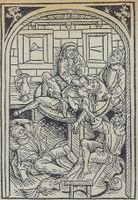
wood cut print
I found this wood cut in a old book about the Renaissance.
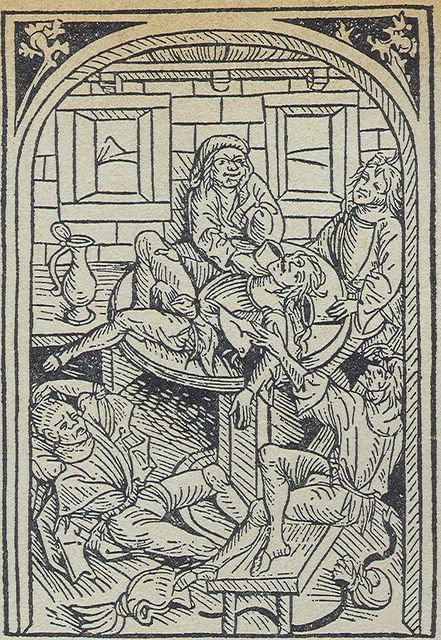
wood cut print
dated 1489
students of Heidelberg College
I think the over indulging student is getting robbed too.
The lament of the parents?
"I sent you to school to get smart! Not to get stupid!"
It's sad that this still happens, and especially when one of these young people dies.
This has been going on long enough! But how do we stop it?
Subscribe to:
Posts (Atom)